Learning objectives
- Measure retracement relative to a fixed impulse leg.
- Treat an equal-leg projection as a scenario with an invalidation rule.
Prerequisites: Identify completed or confirmed swing points and calculate distances.
Mechanism and interpretation
A pullback is a counter-move within a previously defined structure. Freeze the impulse start A and end B before measuring retracement. For an upward impulse, retracement fraction=(B−C)/(B−A), where C is the observed pullback low under the chosen confirmation rule. If C keeps changing, the fraction is developing and should not be presented as final.
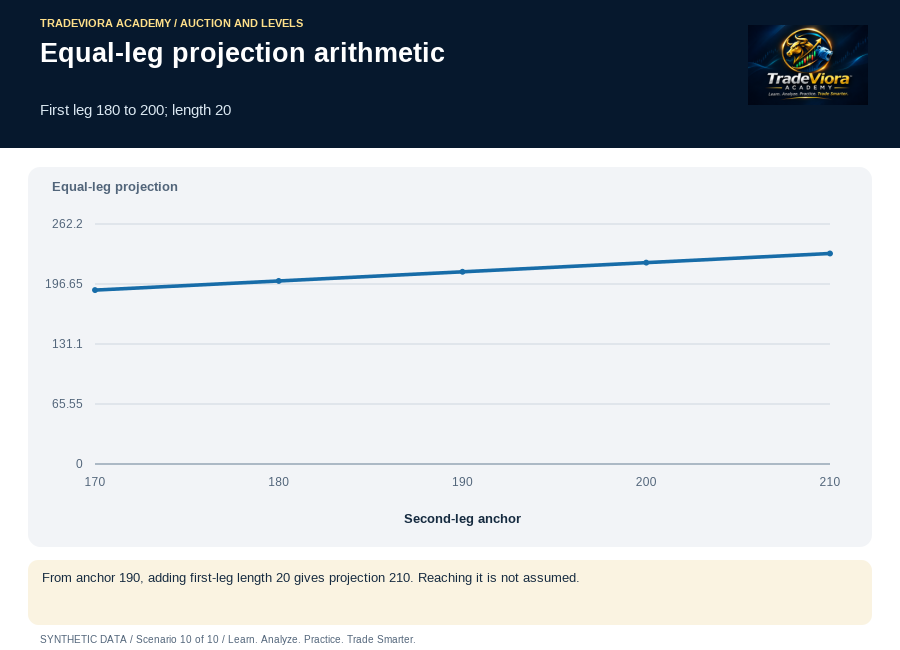
An equal-leg projection adds the first leg's length to C: target hypothesis=C+(B−A). It is a geometric extrapolation, not an expected value or a price promise. Specify what invalidates the underlying structure and how long the hypothesis remains active. Measuring the prettiest impulse after the final target is known makes almost any chart look proportional.
Worked case · synthetic data
Synthetic A=100, B=110, C=106. The impulse length is 10 and pullback depth 4, so retracement=40%. The equal-leg projection is 116. If the scenario requires the pullback to hold above 100, a trade below 100 contradicts that condition even if price eventually reaches 116 weeks later. A projection hit after invalidation is not a successful instance of the originally defined trade.
Failure modes and context
Centered swing algorithms confirm A, B or C with delay. The original high may be exceeded before the pullback low is officially confirmed. Different price scales and log charts change visual symmetry. A wide stop beneath the impulse origin can make the projected reward unattractive after costs, despite a compelling geometric drawing.
Practice assignment
For A=200, B=218, C=209, calculate impulse length, retracement percentage and equal-leg projection. If a scenario expires after ten bars and the projected price occurs on bar fourteen, explain how to classify it. Identify the information needed to know C was usable at entry.
Worked answer
Length=18, pullback=9 and retracement=50%. Projection=209+18=227. A bar-fourteen arrival is outside the ten-bar horizon, so the timed objective was not achieved. The swing or pullback confirmation rule determines when 209 became known; its plotted location alone does not establish entry-time availability.
Check your understanding
Question 1
What is the projection for A=200, B=218, C=209?
- 227
- 218
- 236
Reveal answer and reasoning
A. 227
Add the initial 18-point leg to the pullback endpoint 209.
Question 2
Does a projection define an expected return?
- Yes exactly
- Only on a log chart
- No
Reveal answer and reasoning
C. No
It is an arithmetic scenario; probabilities and costs are separate.
Question 3
Why freeze the impulse endpoints?
- To eliminate pullbacks
- To prevent hindsight selection of favorable legs
- To guarantee symmetry
Reveal answer and reasoning
B. To prevent hindsight selection of favorable legs
Changing endpoints after outcomes changes the hypothesis being evaluated.