
FREE FINANCIAL EDUCATION
Gamma scalping and the cost hurdle
Trace a simple hedge-rebalancing round trip around a long-gamma option.
What you will learn
Prerequisites: Positive gamma, delta hedging and time decay.
- Trace a simple hedge-rebalancing round trip around a long-gamma option.
- Compare realized hedge gains with option decay and trading costs.
- Explain why volatility in the underlying does not guarantee a net profit.
Mechanism and decision rules
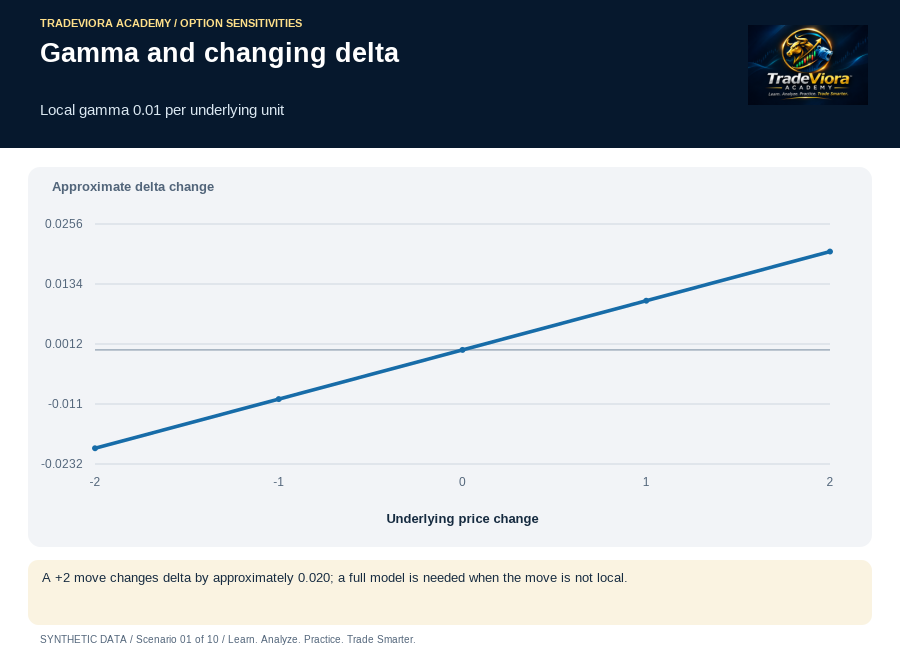
A long-gamma position’s delta rises as the underlying rises and falls as it declines under the local model. Rebalancing toward delta neutrality can involve selling more underlying after a rise and buying it back after a decline. The resulting hedge trades can realize gains on oscillation, but the option was purchased at a premium and often loses value through time or IV changes.
Gamma scalping therefore compares realized hedge results with the cost of owning optionality and executing adjustments. The path, hedge frequency, spreads, jumps and model accuracy matter. A market can move actively while the combined option-plus-hedge position loses because the paid implied volatility or trading friction was too high.
Worked example · synthetic data
A synthetic 100-unit long option starts with delta 0.50, hedged by short 50 underlying units at 100. Price rises to 102 and option delta becomes 0.60, so another 10 units are sold at 102. Price returns to 100 and delta returns to 0.50, so those extra 10 units are bought back at 100, realizing ₹20 on the adjustment.
Assume the option’s value at the returned spot has fallen ₹15 from time effects, IV is unchanged and total hedge costs are ₹8. The simplified combined contribution is 20−15−8=−₹3. The initial 50-unit hedge has zero price P&L over the round trip, so it adds no hidden gain.
Failure modes and limits
This is a deliberately simplified path, not a universal gamma-profit formula. Delta and gamma change continuously, and jumps cannot be hedged continuously. Financing, borrow and spreads add costs. A favorable hindsight hedge schedule may be impossible to choose live; the rebalancing rule must be fixed before testing.
Practice case
A hedge adjustment sells 20 units at 205 and buys them back at 202. Option decay over the interval is ₹35 and hedge costs ₹12. Calculate the simplified net contribution and identify one omitted risk.
Reveal the worked answer
Hedge gain is 20×3=₹60. Net contribution is 60−35−12=₹13. Omitted risks include IV changes, imperfect delta estimates, jumps, financing and additional unmodeled fills. Positive arithmetic in one path is not evidence of a repeatable edge.
Check your understanding
Sources and next steps
The lesson, calculations and synthetic cases are original educational material. References explain underlying contract or chart conventions; none validates the profitability of a trading rule. Actual contract specifications, settlement obligations and charges must be checked before trading.
Explore OHLCV data in the chart lab · Explore volume-at-price and TPO data · Practice library
Related quantitative practice
This separate synthetic case illustrates the arithmetic behind the topic. Its invented inputs are independent of the worked example above.
Download this concept’s cheat sheet · Explore scenario illustrations