
FREE FINANCIAL EDUCATION
Short straddle tail risk
Derive the short straddle’s premium-minus-absolute-move payoff.
What you will learn
Prerequisites: Long-straddle payoff and short-option obligations.
- Derive the short straddle’s premium-minus-absolute-move payoff.
- Calculate breakevens and distinguish them from loss limits.
- Explain the asymmetry of unbounded upside-price risk and large downside risk.
Mechanism and decision rules
A short straddle sells a call and put at the same strike and expiry with matching units. With total credit C, expiry profit is C−|S−K|. Maximum profit occurs at the strike and equals the credit. Breakevens are K−C and K+C, but losses continue beyond those prices; they are not protective boundaries.
For a nonnegative underlying, the downside loss at zero is K−C, while upward price risk is unbounded in the simplified model because the short call’s liability grows with S. Positive theta and a high frequency of quiet expiries do not cap those tails. Margin is collateral, not a maximum-loss guarantee, and requirements can rise during adverse movement.
Worked example · synthetic data
A synthetic strike 100 straddle receives ₹12 total credit. At expiry S=₹100, profit is ₹12. At ₹115, absolute intrinsic liability is ₹15, leaving −₹3. At ₹150, loss is ₹38; the upper breakeven ₹112 did not stop further loss.
Lower breakeven is ₹88. AtS=0, loss is ₹88 per unit under the nonnegative-underlying assumption. A 100-unit position would lose ₹8,800 there before charges. On the upside, no finite maximum follows from the naked short-call payoff.
Failure modes and limits
The model assumes intact same-expiry legs and excludes settlement and execution complications. A stop or adjustment can reduce exposure only if executable and can realize losses on multiple paths. Short gamma can make delta change adversely as price moves. Tail scenarios and liquidity funding matter more than premium collected alone.
Practice case
A strike 200 short straddle receives ₹18. Calculate expiry P&L at 230 and 170, the breakevens and whether either breakeven is a maximum-loss boundary.
Reveal the worked answer
Both 230 and 170 are 30 points from strike, so profit is 18−30=−₹12 per unit. Breakevens are 182 and 218. Neither limits loss; farther settlement moves increase liability, with unbounded upward-price risk from the short call.
Check your understanding
Sources and next steps
The lesson, calculations and synthetic cases are original educational material. References explain underlying contract or chart conventions; none validates the profitability of a trading rule. Actual contract specifications, settlement obligations and charges must be checked before trading.
Explore OHLCV data in the chart lab · Explore volume-at-price and TPO data · Practice library
Related quantitative practice
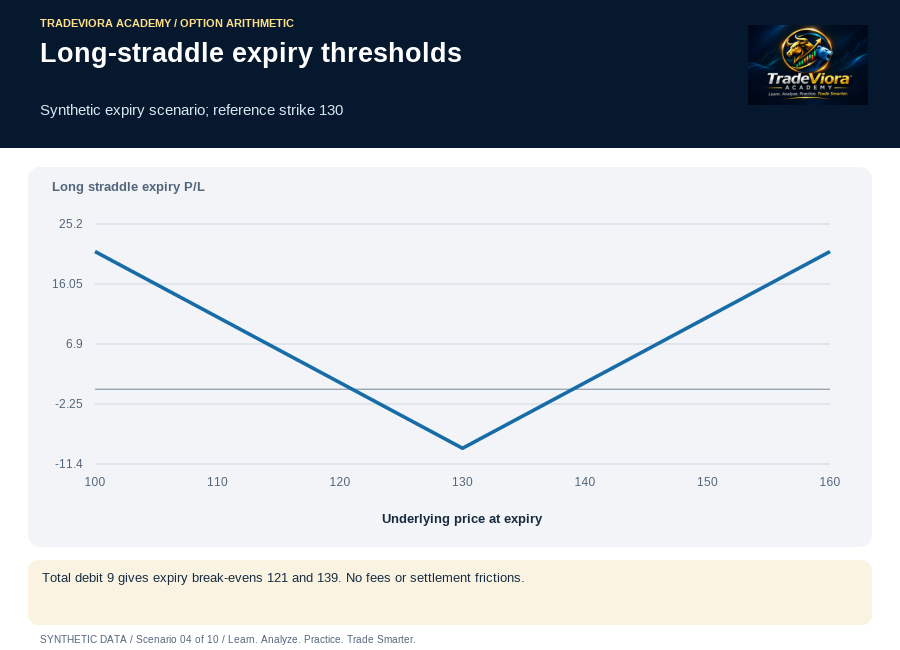
This separate synthetic case illustrates the arithmetic behind the topic. Its invented inputs are independent of the worked example above.
Download this concept’s cheat sheet · Explore scenario illustrations