
FREE FINANCIAL EDUCATION
Bid–ask marking and liquidation value
Separate midpoint account marks from a stated executable-side liquidation estimate.
What you will learn
Prerequisites: Option premium multipliers, long versus short positions and order-book quotes.
- Separate midpoint account marks from a stated executable-side liquidation estimate.
- Include depth and transaction costs in a hypothetical close-out calculation.
Mechanism and decision rules
An option midpoint is the average of the displayed bid and ask. It can be a useful reference mark, but it is not a promise that an order can execute there. A long position sold to close ordinarily interacts with available bids; a short position bought to close interacts with offers. A limit order can seek price improvement but may not fill. Quote size and the state of the book matter alongside the displayed best price.
Build a cash ledger using entry fills and a clearly stated exit assumption. Multiply the per-unit premium difference by contract quantity and unit size, then deduct specified fees. Mark-to-midpoint P&L and an immediate liquidation estimate answer different questions. Neither should be presented as a realized result until an actual closing transaction is completed.
For a larger order, the best quote may cover only part of the position. A depth scenario can allocate quantities across several prices and compute the weighted proceeds. That is still conditional on those quotes remaining available when the order arrives. Simultaneous cancellations, partial fills and market movement can change the outcome. Avoid inferring liquidity from open interest alone or assuming a stale last price is currently tradable.
Worked example · synthetic data
A hypothetical buyer holds four calls of 50 units each, purchased at the ask of 2.40, for 480 total premium. The current quote is 2.00 bid and 2.40 ask. A 2.20 midpoint values the position at 440, a 40 mark loss. Assuming enough current bid size, immediate sale at 2.00 yields 400 and an 80 gross loss; with total entry-and-exit fees of 12, net loss is 92. If only two contracts can sell at 2.00 and the other two at 1.90, proceeds instead total 390 and net loss is 102.
Failure modes and limits
The example uses hypothetical depth and fixed fees, not current market quotes. Selling a long option can involve exercise or tax considerations, but those are separate from the quoted-price arithmetic. A short close-out must use the buy side of the book, reversing the tempting midpoint assumption. Display whether a reported P&L uses last, mid, bid, ask or actual fill, and include currency conversion if premium and account currencies differ.
Practice case
Three long options cover 100 units each and were bought at 1.80. The current quote is 1.50 bid and 1.80 ask, with sufficient displayed bid size for the hypothetical calculation. Total entry-and-exit fees are 15. Calculate entry cash, midpoint value and P&L, liquidation proceeds, and net liquidation P&L. Explain why entering a sell limit at the midpoint does not make that midpoint result realized.
Reveal the worked answer
Entry cash is 540. The 1.65 midpoint gives a value of 495 and a 45 mark loss before fees. Selling at the assumed 1.50 bid yields 450, a 90 gross loss and 105 net loss after fees. A limit at 1.65 merely specifies an acceptable minimum sale price; it may remain unfilled. Only confirmed fills establish realized proceeds, and displayed size can change before the order executes.
Check your understanding
Sources and next steps
The lesson, calculations and synthetic cases are original educational material. References explain underlying contract or chart conventions; none validates the profitability of a trading rule. Actual contract specifications, settlement obligations and charges must be checked before trading.
Explore OHLCV data in the chart lab · Explore volume-at-price and TPO data · Practice library
Related quantitative practice
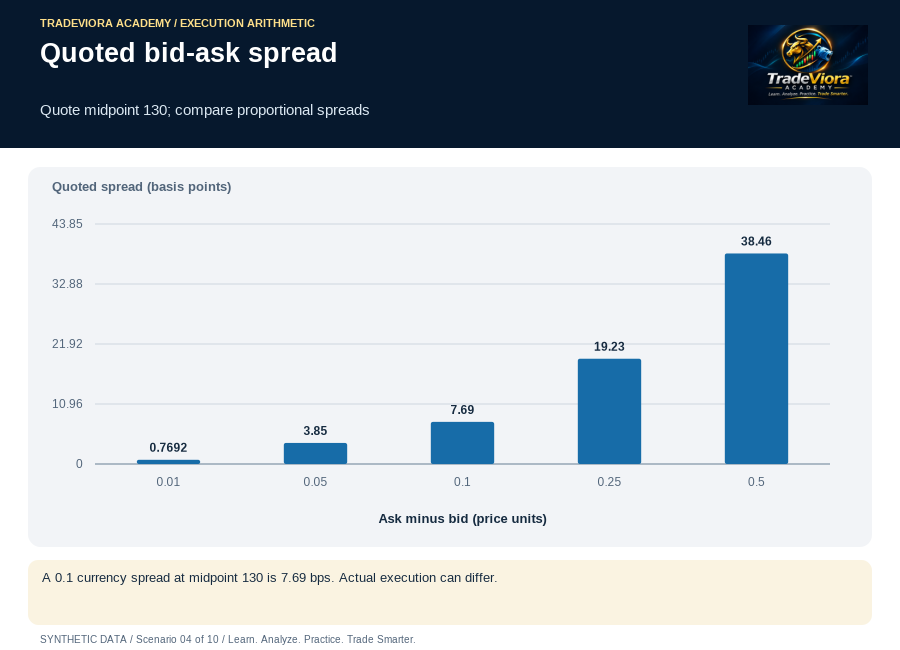
This separate synthetic case illustrates the arithmetic behind the topic. Its invented inputs are independent of the worked example above.
Download this concept’s cheat sheet · Explore scenario illustrations