
1. Can last-trade prices alternate while the quote midpoint stays fixed?
- No
- Only if no trades occur
- Yes
Reveal answer and explanation
C. Transactions can alternate between unchanged bid and ask prices.
FREE FINANCIAL EDUCATION
Study bid-ask bounce and transaction-price noise through mechanisms, a synthetic worked case, practice, and explained assessment.
APPLIED STUDY · ORIGINAL LESSON
Before you begin: Complete exchange order-book and candle-anatomy lessons.
The last traded price and the current quoted market are different objects. With an unchanged bid and ask, a buyer demanding immediacy may trade at the ask and a seller at the bid. Alternating trades can make the transaction-price series move up and down even though the quote midpoint is unchanged. This bid-ask bounce can create small apparent reversals, candle bodies or volatility that mainly reflect which side traded rather than a change in the centre of available quotes.
For a simple quote, midpoint=(bid+ask)/2 and spread=ask−bid. A transaction's distance from midpoint helps describe where it occurred, but does not by itself identify all execution conditions or hidden liquidity. Quotes can change between timestamps, and trades can occur inside the displayed spread. Use synchronised trade and quote data when studying this effect. Candle OHLC alone cannot reconstruct the contemporaneous spread or prove that a small zigzag came from bid-ask bounce.
Synthetic quotes remain bid 99.90 and ask 100.10. Midpoint is 100 and spread 0.20. Trades occur at 100.10,99.90,100.10,99.90. The last-trade series alternates by 0.20, while midpoint remains 100 throughout. A candle covering those trades has open 100.10, high 100.10, low 99.90 and close 99.90, producing a red body of 0.20. Calling it evidence of a directional shift without quote context overstates what occurred.
If a trader buys at 100.10 and immediately sells at 99.90 for 100 units with unchanged quotes, the gross round-trip loss is₹20 before fees. A backtest that assumes both trades occur at midpoint 100 would erase that spread cost. Conversely, the midpoint's stability does not prove unlimited executable size at either quote; displayed quantities may be small and can disappear before an order arrives.
Microstructure effects are more visible when the spread is large relative to the price movement or bar interval. Tick size, auctions and sparse trading can further shape candles. Do not dismiss every small reversal as noise: the point is to identify what additional quote information is needed, not to replace one unsupported narrative with another.
Quotes are bid 49.95 and ask 50.05, with trades 50.05→49.95→50.05. Compute midpoint, spread, last-trade path length and midpoint path length. Then calculate an immediate 100-unit ask-to-bid round-trip cost before fees.
Midpoint is 50 and spread 0.10. Last-trade path length is 0.10+0.10=0.20, while midpoint path length is 0 under the unchanged-quote assumption. The 100-unit round-trip spread cost is 100×0.10=₹10. The transaction path and quote-centre path measure different movement.
Choose an answer before opening each explanation. These questions test the specific mechanism in this lesson.
C. Transactions can alternate between unchanged bid and ask prices.
A. OHLC summarises trades without necessarily recording the available quotes.
B. A centre quote is not a guarantee that both sides can execute there.
Original explanation and synthetic calculations. Chart thresholds are explicit research conventions, not exchange rules or proof of predictive ability.
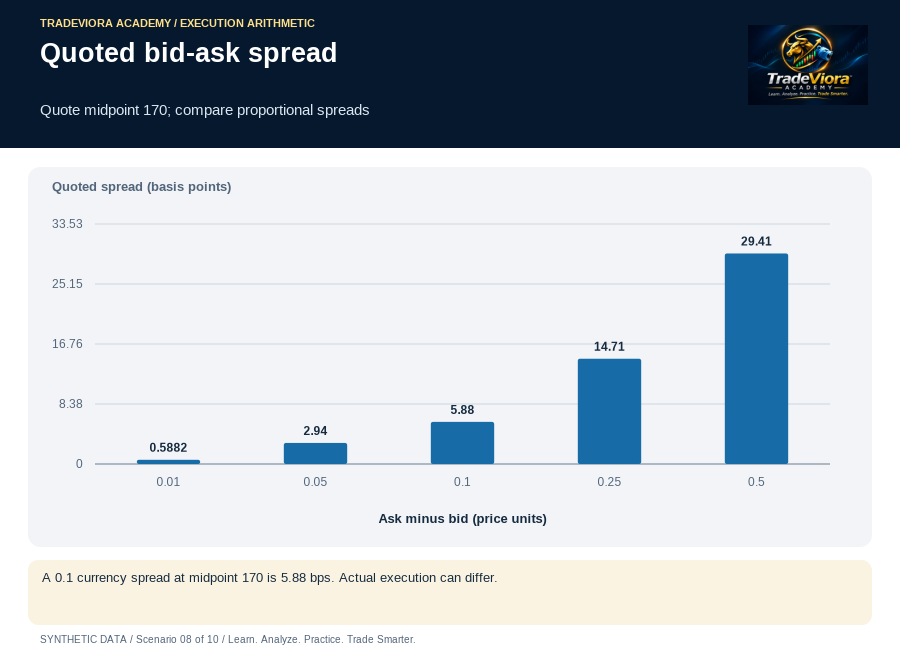
This separate synthetic case illustrates the arithmetic behind the topic. Its invented inputs are independent of the worked example above.
Download this concept’s cheat sheet · Explore scenario illustrations