
FREE FINANCIAL EDUCATION
Dependent loss sequences
Calculate a run probability under an explicit conditional-loss model.
What you will learn
Prerequisites: Conditional probability and independent run calculations.
- Calculate a run probability under an explicit conditional-loss model.
- Compare it with an independence assumption without mixing the two.
- Explain why loss clustering matters to capital and pause policies.
Mechanism and decision rules
Losses may cluster when a strategy repeatedly faces the same adverse regime or shared event. Independence assumes the next outcome probability does not change after a loss; a conditional model can assign a different probability following one. Neither assumption should be chosen merely because it produces a comfortable risk estimate.
A simple two-state model can specify P(next loss|current loss) separately from P(next loss|current win). It is an educational description of dependence, not proof that past losses forecast the next one. The parameters require estimation and can change. Run probabilities under such a model differ from multiplying an unconditional loss rate repeatedly.
Worked example · synthetic data
In a synthetic model, after a loss the probability of another loss is 0.70. Starting immediately after a known loss, the probability the next three are also losses is 0.70³=34.3%, because each successive loss keeps the process in that conditional state.
An independent model with loss probability 0.40 would assign 0.40³=6.4% to the next three losses. The numbers differ because the assumptions differ. They are not two competing arithmetic answers to the same fully specified model, and neither is a lifetime ruin probability.
Failure modes and limits
Small samples make conditional probabilities unstable. A run can occur under independence and does not alone prove a regime change. Strategy adjustments can change the process being estimated. Use clustering analysis alongside execution and market-condition review, without automatically increasing risk after either wins or losses.
Practice case
A declared model has P(loss next|loss now)=0.60. Starting after a loss, calculate the probability of four additional consecutive losses. What assumption allows multiplication here?
Reveal the worked answer
The probability is 0.60⁴=12.96%. The model assumes the same conditional transition probability applies at each step and that the current state summarizes the relevant dependence. If longer history or changing conditions matter, that simple multiplication may not represent the process.
Check your understanding
Sources and next steps
The lesson, calculations and synthetic cases are original educational material. References explain underlying contract or chart conventions; none validates the profitability of a trading rule. Actual contract specifications, settlement obligations and charges must be checked before trading.
Explore OHLCV data in the chart lab · Explore volume-at-price and TPO data · Practice library
Related quantitative practice
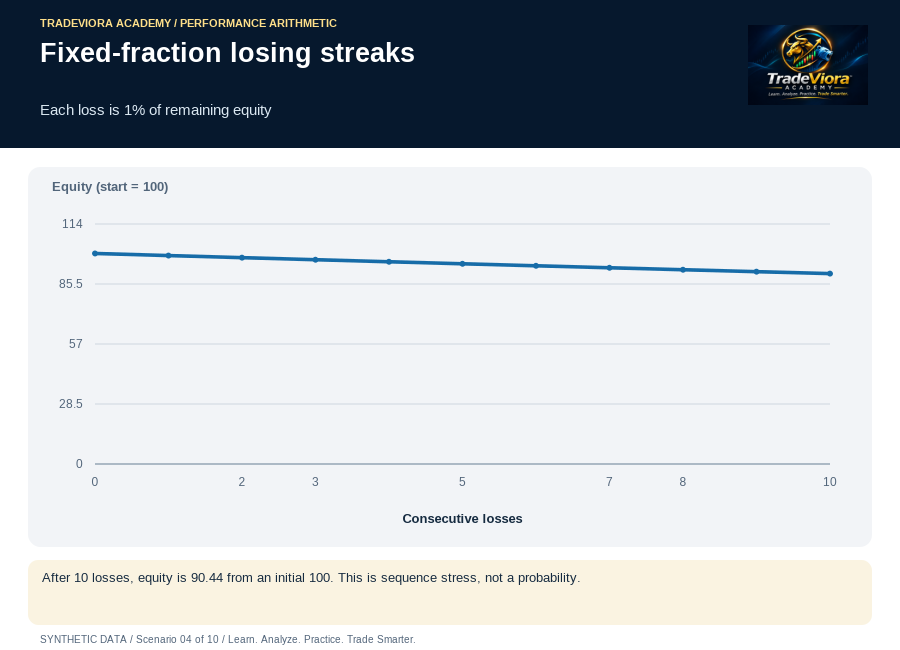
This separate synthetic case illustrates the arithmetic behind the topic. Its invented inputs are independent of the worked example above.
Download this concept’s cheat sheet · Explore scenario illustrations