
FREE FINANCIAL EDUCATION
Volatility targeting and leverage caps
Compute a simple target-volatility exposure multiplier.
What you will learn
Prerequisites: Return volatility, exposure weights and estimation lag.
- Compute a simple target-volatility exposure multiplier.
- Apply a separate leverage cap and funding constraint.
- Explain why a lagging estimate cannot guarantee realized risk.
Mechanism and decision rules
A simple volatility-targeting rule scales exposure by target volatility divided by estimated strategy volatility. If the estimate is 20% and target 10%, the multiplier is 0.5 under a linear exposure approximation. The estimate’s window, update frequency and annualization must be specified. Cash return and financing can matter when exposure differs from one times equity.
The rule adapts to measured risk, but the measurement is backward-looking or model-based. Low recent volatility can call for larger exposure just before a jump. A leverage cap, minimum volatility floor and turnover rule can limit extreme responses, though each adds a design choice. Volatility targeting is not a guarantee that realized volatility equals the target.
Worked example · synthetic data
A synthetic strategy’s estimated annual volatility is 20%, with target 10%, so exposure multiplier is 0.5. On ₹500,000 equity, modeled notional is ₹250,000. If the estimate later falls to 5%, the raw multiplier becomes 2.0, but a predeclared 1.2 cap limits notional to ₹600,000.
If actual future strategy volatility suddenly becomes 30%, the capped 1.2 exposure could imply roughly 36% volatility under the simple linear model, far above the 10% target. The cap constrains leverage, but neither it nor the stale estimate predicts the future distribution.
Failure modes and limits
Nonlinear instruments and changing correlations violate simple proportional scaling. Transaction costs rise with rebalancing. Estimates can react after losses have already occurred. A low-volatility floor and cap should be selected through a disciplined process, not optimized only to remove the worst historical event.
Practice case
Target volatility is 12%, estimate 30% and equity ₹500,000. Compute exposure multiplier and notional. If the estimate rises to 60%, what does the same rule request before other constraints?
Reveal the worked answer
Initial multiplier is 12/30=0.4 and notional ₹200,000. At 60%, multiplier becomes 0.2 and notional ₹100,000. The rule would reduce ₹100,000 of exposure, subject to execution, cash and minimum-unit constraints.
Check your understanding
Sources and next steps
The lesson, calculations and synthetic cases are original educational material. References explain underlying contract or chart conventions; none validates the profitability of a trading rule. Actual contract specifications, settlement obligations and charges must be checked before trading.
Explore OHLCV data in the chart lab · Explore volume-at-price and TPO data · Practice library
Related quantitative practice
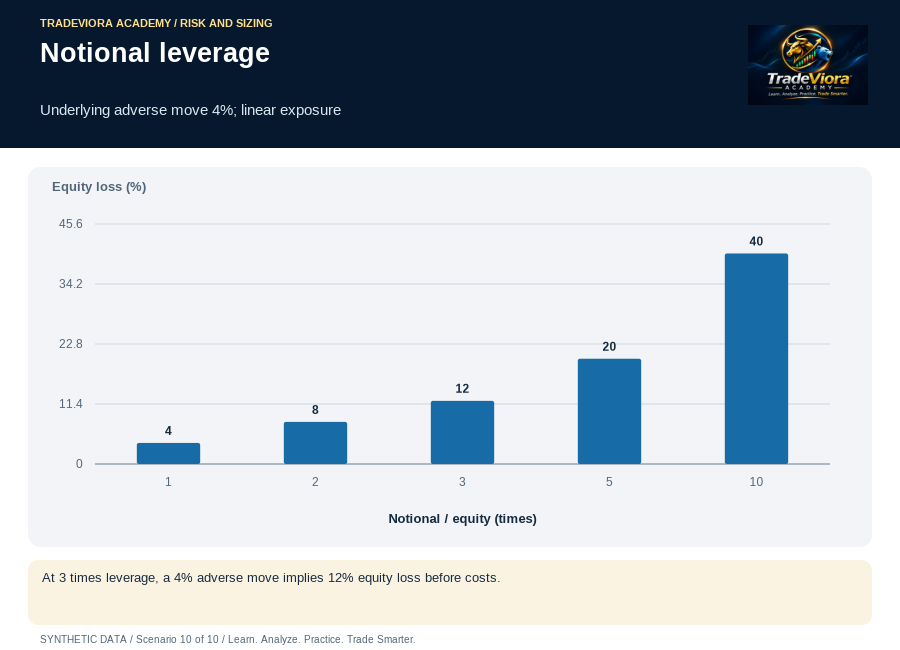
This separate synthetic case illustrates the arithmetic behind the topic. Its invented inputs are independent of the worked example above.
Download this concept’s cheat sheet · Explore scenario illustrations