FREE FINANCIAL EDUCATION
Volatility-normalized cross-stock sizing
Allocate equal hypothetical currency exposure to one ATR move across different stocks.
What you will learn
Prerequisites: ATR, percentage range, notional value and share quantities.
- Allocate equal hypothetical currency exposure to one ATR move across different stocks.
- Distinguish equal notional weights from equal range-scaled exposure.
Mechanism and decision rules
Equal purchase amounts do not necessarily create equal exposure to ordinary price movement. A stock whose typical range is four percent of price can move twice as much in currency terms as a two-percent-range stock with the same notional position. A range-normalized sizing rule uses an explicit volatility proxy to scale quantities before checking cash and portfolio constraints.
This lesson uses ATR as a price-unit scale, not as a standard deviation or a complete probability model. To allocate a chosen currency amount to a one-ATR movement, divide that amount by each stock’s ATR. The resulting quantities may have different notionals because ATR relative to price differs. If a planned stop is two ATRs away, its simple price-loss amount is twice the one-ATR allocation before execution effects.
The exercise equalizes one selected measure, not every form of risk. Stocks can have different gaps, event exposure, liquidity, borrowing terms and correlations. A small ATR after a quiet period can imply a large share count immediately before a surprise. Apply independent limits rather than treating the normalization formula as an instruction to invest an unlimited amount in a calm-looking stock.
Worked example · synthetic data
Stock A is 100 with ATR 2; stock B is 250 with ATR 10. Their ATR percentages are 2% and 4%. A hypothetical allocation of 600 per one-ATR move gives 300 shares of A and 60 of B. Notionals are 30,000 and 15,000, but each one-ATR move produces 600 price P&L in magnitude. A two-ATR planned adverse move produces 1,200 for either. By contrast, equal notionals of 22,500 would buy 225 A shares and 90 B shares, producing one-ATR magnitudes of 450 and 900.
Failure modes and limits
ATR normalization is sensitive to smoothing, sample length and corporate-action adjustments. Price gaps can exceed several ATRs, and correlations may rise during a shared shock. Whole-share rounding and minimum lots can prevent exact equality. Record the actual achieved exposure after rounding, and avoid presenting an ATR-based amount as a statistical confidence limit or expected shortfall.
Practice case
Stock C is 80 with ATR 4; stock D is 200 with ATR 5. Allocate 500 of currency exposure to a one-ATR move in each. Calculate ATR percentages, quantities and notionals. What simple planned loss follows a two-ATR adverse move in each position? Explain why the higher-notional holding need not have higher risk under this particular single-measure comparison.
Reveal the worked answer
ATR percentages are 5% for C and 2.5% for D. Quantities are 500/4 = 125 and 500/5 = 100 shares, with notionals 10,000 and 20,000. Two ATRs correspond to 1,000 planned price loss for each. The larger D notional is offset by its smaller range relative to price in this model. Other risks remain different, so the result is equalization of one chosen scale rather than proof of equal overall safety.
Check your understanding
Sources and next steps
The lesson, calculations and synthetic cases are original educational material. References explain underlying contract or chart conventions; none validates the profitability of a trading rule. Actual contract specifications, settlement obligations and charges must be checked before trading.
- www.tradingview.com: reference documentation
- www.cmegroup.com: reference documentation
- www.cmegroup.com: reference documentation
Explore OHLCV data in the chart lab · Explore volume-at-price and TPO data · Practice library
Related quantitative practice
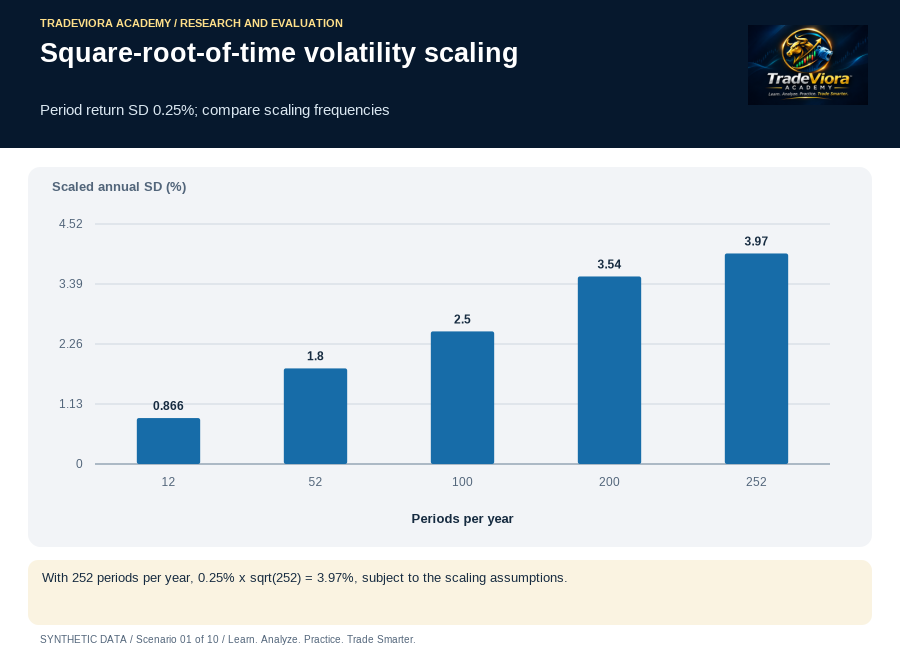
This separate synthetic case illustrates the arithmetic behind the topic. Its invented inputs are independent of the worked example above.
Download this concept’s cheat sheet · Run the related Python example · Explore scenario illustrations
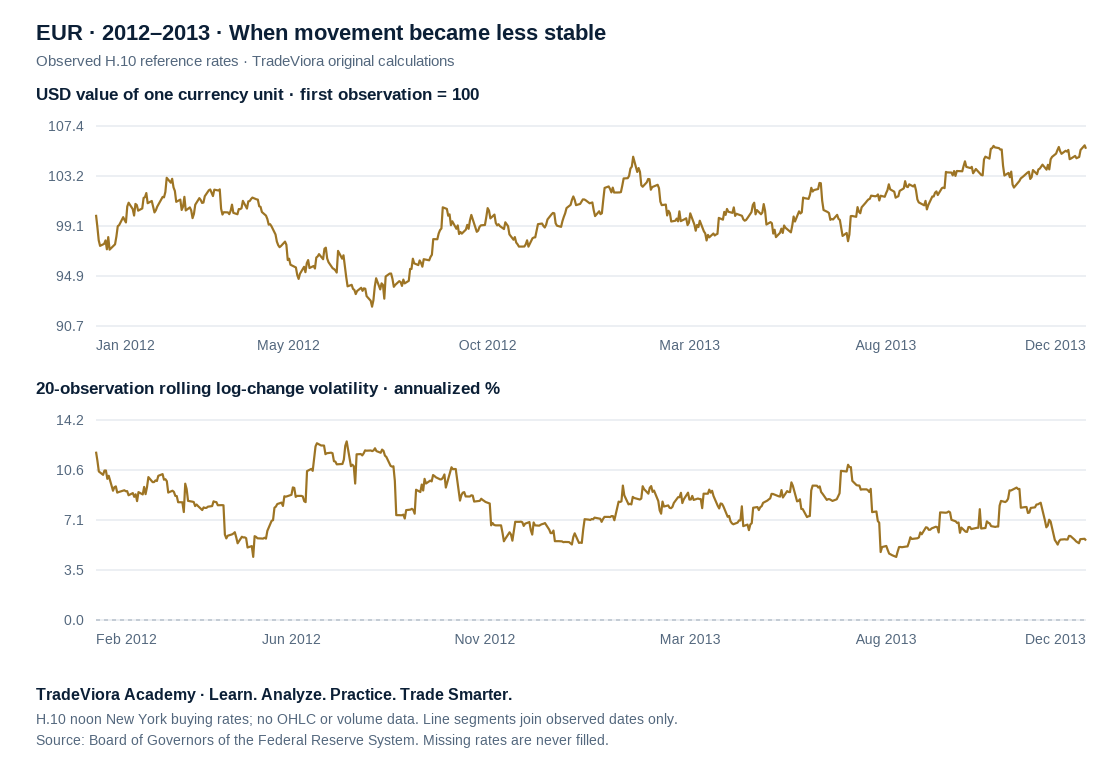
Apply the measurement to genuine historical data
Euro, 2012–2013: when movement became less stable uses Federal Reserve H.10 reference-rate observations. It is an FX measurement exercise, not a test of a trading strategy or an OHLC candlestick record.