Learning objectives
- Measure time below a prior equity high using an explicit recovery rule.
- Record an ongoing drawdown as censored rather than assigning a completed duration.
Prerequisites: Calculate running equity peaks and distinguish trading observations from calendar time.
Mechanism and interpretation
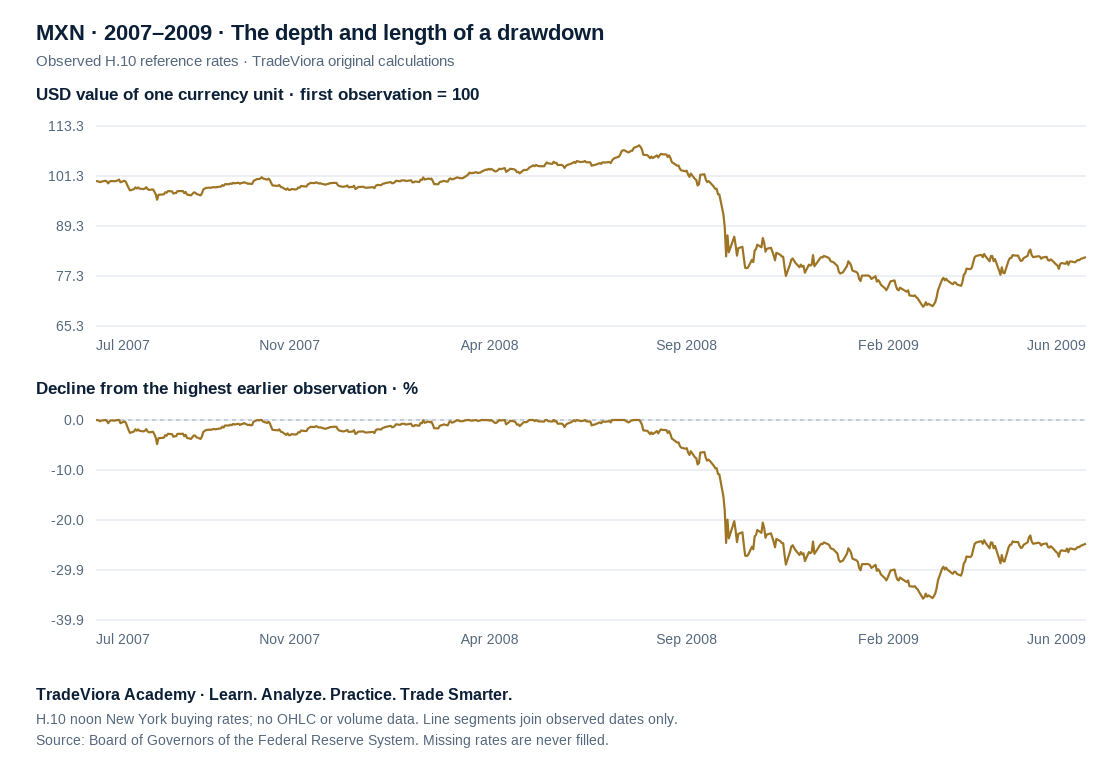
Drawdown depth measures distance below a previous high; duration measures how long recovery takes. Define the start at the prior peak observation and recovery as the first later observation with equity at or above that peak. Count elapsed intervals, not the number of printed values, unless another convention is stated. Equal-peak handling should be explicit.
An ongoing drawdown at the dataset end has no observed recovery time. Its duration is right-censored:we know it has lasted at least the observed elapsed time, but not its final length. Averaging only completed recoveries can understate time underwater because long unfinished episodes disappear. NIST's censoring framework supports the general time-to-event principle; the equity application here is an original example.
Worked case · synthetic data
Synthetic equity at observations 0–5 is 100,110,105,108,111,109. The peak 110 occurs at 1 and is recovered at 4, so the completed peak-to-recovery duration is 3 intervals. The new peak 111 at 4 is followed by 109 at 5, creating an ongoing episode observed for 1 interval. It must not be labeled a completed one-interval recovery.
Failure modes and context
Deposits and withdrawals can create artificial equity peaks unless returns or wealth are adjusted appropriately. Sparse sampling can miss intraday recovery or deeper losses. Calendar duration and session count differ across holidays. Different strategies can have the same maximum depth but very different recovery times, which matters for capital commitments and investor behavior.
Practice assignment
Equity at observations 0–6 is 200,220,210,215,220,225,219. Using recovery at equity≥old peak, identify the completed episode and its duration. Identify the censored episode at the end. Explain how requiring a strictly higher recovery value would change the first episode.
Worked answer
Peak 220 at 1 is recovered by equality at 4, so duration 3 intervals. Peak 225 at 5 is unrecovered at 6 and censored after 1 interval. If recovery required strictly exceeding 220, the first episode would end at 5 instead, lasting 4 intervals. The chosen equality policy changes the result and must be stated before comparison.
Check your understanding
Question 1
Is an unrecovered final drawdown a completed short duration?
- Only if the loss is small
- No; it is censored
- Yes
Reveal answer and reasoning
B. No; it is censored
The eventual recovery time has not been observed.
Question 2
How many intervals separate observations 1 and 4?
- Three
- Four
- Two
Reveal answer and reasoning
A. Three
Elapsed intervals are the difference between endpoint indices,4−1=3, not the count of printed values.
Question 3
Why can completed-only averages understate duration?
- Every episode has equal length
- Censoring always adds zero
- Long unfinished episodes are omitted
Reveal answer and reasoning
C. Long unfinished episodes are omitted
The sample excludes recoveries that have not yet occurred, which may be the longest.