
FREE FINANCIAL EDUCATION
Swing position sizing
Apply both stop-distance and overnight-stress constraints to a swing position.
What you will learn
Prerequisites: Cash position sizing, overnight gaps and portfolio constraints.
- Apply both stop-distance and overnight-stress constraints to a swing position.
- Choose the smaller quantity allowed by multiple independent limits.
- Explain why an account’s cash balance is not its risk allowance.
Mechanism and decision rules
Swing sizing must account for both the planned exit and the possibility of a gap before that exit can execute. One approach computes a quantity from stop-distance risk and separately computes a quantity from an adverse overnight scenario. The final size is the minimum allowed by these and other constraints, such as cash, sector exposure and minimum tradable units.
These are scenario-based limits, not guarantees. A more severe gap can still exceed the chosen stress. The benefit is that the sizing decision explicitly recognizes a risk omitted by ordinary stop arithmetic. A position that fits available cash may nevertheless violate the risk budget; conversely, a risk-sized quantity may require more funding than the account can supply.
Worked example · synthetic data
Synthetic equity is ₹400,000. The planned-loss allowance is ₹2,000 and the overnight-stress allowance ₹4,000. A stock entry is ₹500, planned stop ₹490 and stressed executable exit ₹470. Stop-based quantity is 2,000/10 = 200 shares. Stress-based quantity is floor(4,000/30) = 133 shares.
The stricter result is 133 shares, costing ₹66,500 before fees. Planned stop loss is ₹1,330 and stressed loss ₹3,990. Choosing 200 simply because it fits the stop budget would violate the separate overnight limit.
Failure modes and limits
Stress prices are assumptions and should not be tuned to justify a desired size. Corporate events and correlated holdings can create larger combined losses. Financing, borrow and delivery constraints may further limit quantity. A minimum derivative lot can make a valid analytical setup unsuitable for the account.
Practice case
Entry is ₹300, stop ₹294 and stress exit ₹280. Planned allowance is ₹1,200, stress allowance ₹2,500 and available purchase cash ₹30,000. Calculate each allowed quantity and the final maximum.
Reveal the worked answer
Stop-based quantity is 200. Stress-based quantity is floor(2,500/20) = 125. Cash permits 30,000/300 = 100. The final maximum is 100 shares, satisfying all three constraints before charges. No single limit overrides the others.
Check your understanding
Sources and next steps
The lesson, calculations and synthetic cases are original educational material. References explain underlying contract or chart conventions; none validates the profitability of a trading rule. Actual contract specifications, settlement obligations and charges must be checked before trading.
Explore OHLCV data in the chart lab · Explore volume-at-price and TPO data · Practice library
Related quantitative practice
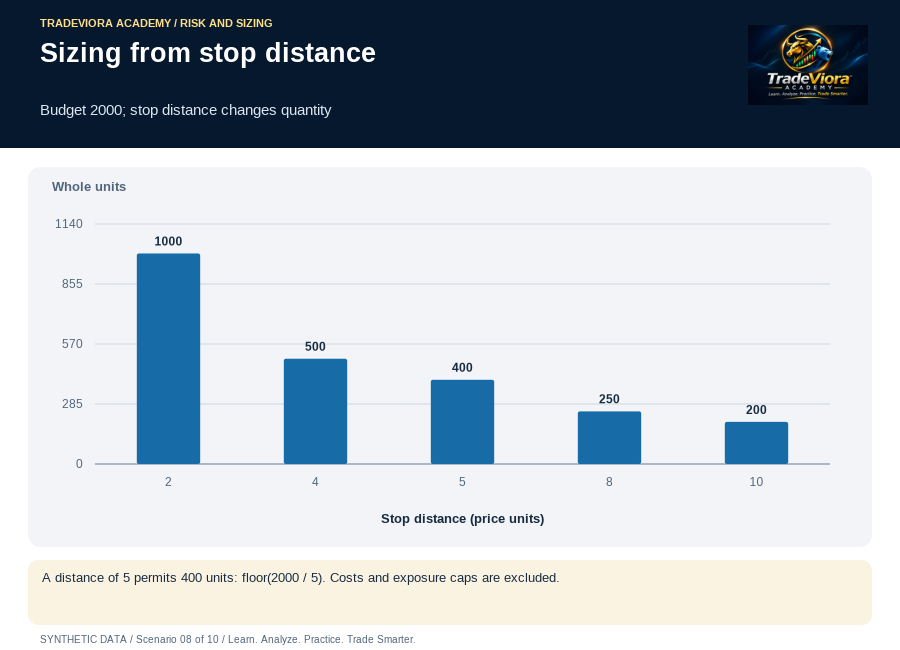
This separate synthetic case illustrates the arithmetic behind the topic. Its invented inputs are independent of the worked example above.
Download this concept’s cheat sheet · Try the related calculator · Run the related Python example · Explore scenario illustrations