
FREE FINANCIAL EDUCATION
Delta
Apply delta as a local price-sensitivity approximation.
What you will learn
Prerequisites: Option premium, small price changes and contract unit size.
- Apply delta as a local price-sensitivity approximation.
- Aggregate signed delta across option units and underlying holdings.
- Explain why delta is not a fixed leverage ratio or universal profit probability.
Mechanism and decision rules
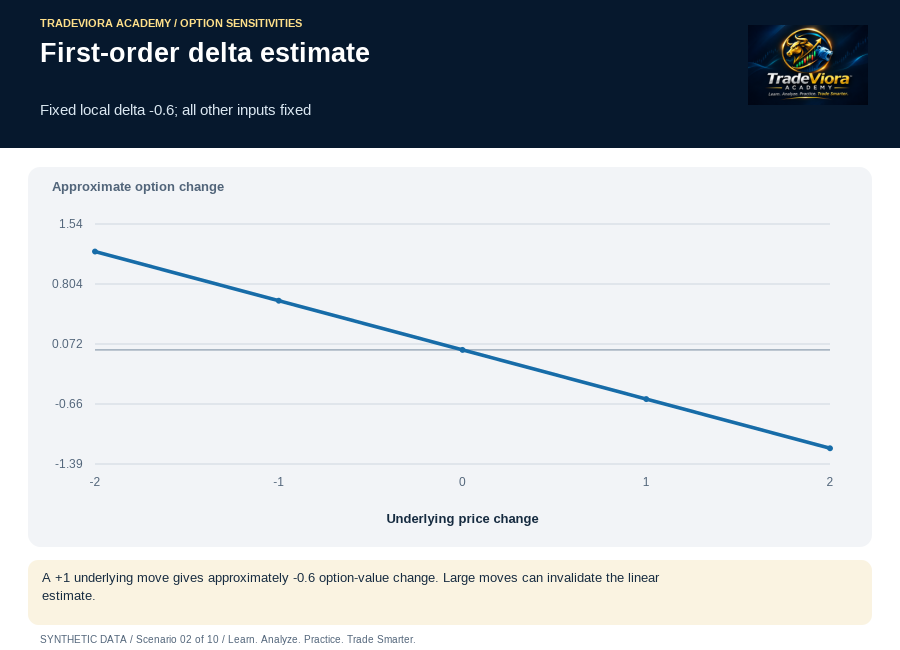
Delta is the derivative of option value with respect to the underlying price under a stated model and input convention. A delta of 0.60 means an approximate ₹0.60 option-value change for a small ₹1 rise in the underlying, holding other modeled inputs constant. Standard long calls typically have positive delta and long puts negative delta; a short position reverses the sign.
Position delta multiplies per-unit delta by contract units, number of contracts and position sign. It is useful for a first-order directional approximation, but it changes as price, time and volatility change. Delta is sometimes used as a rough moneyness or probability proxy under particular models, yet it is not universally the probability of expiry profit. Profit also depends on premium, path and exit decisions.
Worked example · synthetic data
A synthetic call has delta 0.60, unit size 50 and a long position of three contracts. Position delta is 0.60 × 50 × 3 = 90 underlying-equivalent units. For a small ₹2 underlying rise, the first-order option gain is approximately ₹180, before other input changes.
Add a long put position with delta −0.35 across 100 units. It contributes −35 delta, leaving net +55. A short holding of 55 underlying units would make the instantaneous first-order net delta approximately zero. It would not eliminate gamma, vega, time decay or future rehedging needs.
Failure modes and limits
Large moves invalidate a fixed-delta approximation because gamma changes delta. Model inputs and quote quality matter. Cross-asset deltas cannot be added as raw unit counts without an appropriate conversion. A delta-neutral portfolio can still lose from volatility, time, jumps and transaction costs.
Practice case
You are short two calls, each with delta 0.40 and fictional unit size 75. You also own 30 underlying units. Calculate net delta and approximate P&L for a small ₹1 rise, holding other inputs fixed.
Reveal the worked answer
Short-call delta is −2 × 75 × 0.40 = −60. Adding +30 underlying units gives net −30. The first-order P&L for a ₹1 rise is approximately −₹30. This local estimate omits curvature and simultaneous changes in volatility and time.
Check your understanding
Sources and next steps
The lesson, calculations and synthetic cases are original educational material. References explain underlying contract or chart conventions; none validates the profitability of a trading rule. Actual contract specifications, settlement obligations and charges must be checked before trading.
Explore OHLCV data in the chart lab · Explore volume-at-price and TPO data · Practice library
Related quantitative practice
This separate synthetic case illustrates the arithmetic behind the topic. Its invented inputs are independent of the worked example above.
Download this concept’s cheat sheet · Try the related calculator · Explore scenario illustrations