
FREE FINANCIAL EDUCATION
Theta
Interpret the sign and unit convention of a reported theta.
What you will learn
Prerequisites: Option premium, time-to-expiry and holding other inputs constant.
- Interpret the sign and unit convention of a reported theta.
- Estimate a short time-step effect without treating theta as guaranteed income.
- Explain why time decay is not linear across the option’s life.
Mechanism and decision rules
Theta describes option-value sensitivity to the passage of time under a stated convention. Many trading displays quote expected value change per calendar day with other inputs held constant, while some systems use annual or trading-day units or the derivative with respect to remaining time. Check both sign and units before multiplying. A standard long option often has negative passage-of-time theta, but contract carry and special circumstances can complicate simple rules.
A short option reverses the local theta sign, yet positive theta is not earned independently of risk. The position can lose more through underlying movement or volatility than it gains from a day passing. Theta changes with moneyness, remaining life and other inputs. Multiplying today’s theta by thirty does not generally predict the next month’s option decline.
Worked example · synthetic data
A synthetic option is quoted at ₹20 and has passage-of-time theta −₹0.30 per unit per calendar day. Holding price, volatility and other inputs fixed for a very short step, a one-day estimate is ₹19.70. For 100 long units, the theta contribution is approximately −₹30.
If the same day’s underlying move contributes +₹1.20 per unit and a volatility decline contributes −₹0.50, the combined local estimate is +1.20 − 0.50 − 0.30 = +₹0.40 per unit. Negative theta did not prevent a gain, and positive theta would not have guaranteed one.
Failure modes and limits
The local approximation omits changes in theta and cross-effects. Calendar-day and trading-day conventions differ, especially around weekends. A broker’s displayed theta may use a model that does not match actual market repricing. Expiry payoff discontinuities and settlement mechanics cannot be captured by a constant daily-decay line.
Practice case
A short position represents 150 option units whose long-option theta is −₹0.08 per unit per day. What is the short position’s estimated one-day theta contribution? Why is it not a guaranteed cash receipt?
Reveal the worked answer
The short reverses the sign, giving +150 × 0.08 = ₹12 of estimated value contribution. It is a model sensitivity, not a scheduled payment. Price moves, volatility changes, spread costs and changing sensitivities can overwhelm or reverse the total P&L.
Check your understanding
Sources and next steps
The lesson, calculations and synthetic cases are original educational material. References explain underlying contract or chart conventions; none validates the profitability of a trading rule. Actual contract specifications, settlement obligations and charges must be checked before trading.
Explore OHLCV data in the chart lab · Explore volume-at-price and TPO data · Practice library
Related quantitative practice
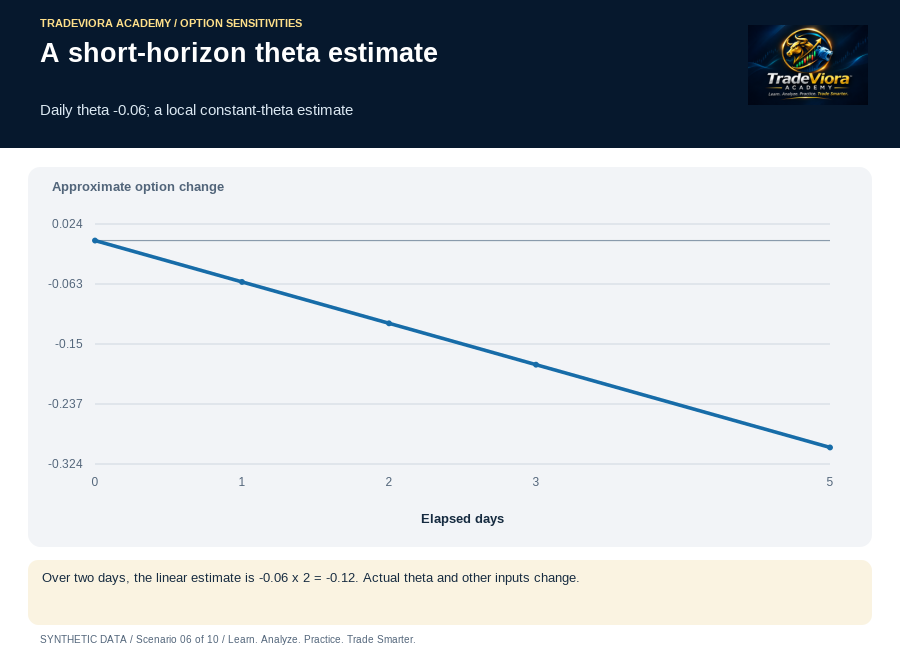
This separate synthetic case illustrates the arithmetic behind the topic. Its invented inputs are independent of the worked example above.
Download this concept’s cheat sheet · Explore scenario illustrations