OBV adds volume on higher closes and subtracts on lower closes.
Free lesson· Module 07 · 9/31
01 / Core concept
Core concept: On-balance volume
OBV adds volume on higher closes and subtracts on lower closes.
How it works
OBV is a cumulative series: add volume when close rises, subtract when it falls, and commonly leave it unchanged when the close is equal. The absolute starting level is arbitrary. Divergence signals require an objective pivot and timing definition.
02 / Worked example
Worked example: On-balance volume
Starting at 0, an up day of 500 and down day of 300 gives 200.
Values from the example above, in order of appearance. Not a live chart.
Try it yourself: OBV=200 and the next close is unchanged on volume 1,000. New OBV?
Explanation: 200 under the unchanged-close convention.
03 / Risk and limitations
Limitations and common mistakes
The indicator ignores the magnitude of price changes.
Separate the observation from the trading decision. Test the rule with realistic execution and costs; a hypothetical example is not evidence of a profitable strategy.
Before you begin: Read volume and prior closing price.
Calculate cumulative signed volume
Handle unchanged closes
Explain information lost by the sign rule
Mechanism and interpretation
OBV adds a bar's full volume when its close exceeds the prior close and subtracts it when the close falls. Under the convention here, an unchanged close adds zero. The starting level is arbitrary; changes and shape matter more than its absolute number. OBV classifies all volume by one endpoint comparison, so a tiny price gain and a large price gain receive the same positive sign if volume is equal.
Worked case — synthetic data
Synthetic closes are 100,102,101,101 and volumes after the initial bar are 1,000,1,500,900. Starting OBV at zero gives 1,000,−500,−500. The flat final close leaves OBV unchanged despite 900 units trading. If the first rise had ended at 100.01 instead of 102, the first OBV change would still be +1,000. This is signed bar volume, not measured buyer-minus-seller order flow.
Context and failure modes
An isolated volume spike can dominate the cumulative series. Changing the dataset start shifts the level, so compare differences over matching windows rather than absolute values across unrelated histories.
Practice task
Starting OBV 5,000, next close falls with volume 700, then rises with volume 400. Calculate the sequence.
Worked practice answer
OBV becomes 4,300 then 4,700. Net change is −300 over the two bars.
Topic assessment
Choose an answer before opening each explanation. These questions test the specific mechanism in this lesson.
1. What happens on an unchanged close under this convention?
Full volume is always subtracted
OBV remains unchanged
Full volume is always added
Reveal answer and explanation
B. Equal-close handling must be declared; this lesson uses zero signed contribution.
2. Does OBV weight the size of the price change?
Yes, proportionally
Only on down bars
No
Reveal answer and explanation
C. It uses the sign of the close change, not its magnitude.
3. Why is the starting level arbitrary?
OBV is a cumulative sum with a chosen origin
Volume has no units
Every platform begins at the same trade
Reveal answer and explanation
A. Adding a constant changes the level without changing subsequent increments.
Further reading
Original TradeViora Academy explanation and hypothetical example. See the primary-reference scope below. External resources do not endorse or independently verify this lesson.
Inspect actual provider-hosted market prices or load your own historical OHLCV in the Market Chart Lab. For volume-at-price and bid/ask analysis, use the profile workbench with appropriate data. These are exploration tools, not verified historical examples of this specific lesson.
Source scope
The explanations, definitions used for chart labels, synthetic cases, and exercises above are original. Exchange documentation is a reference for order mechanics; it does not validate a chart strategy or identify trader intent. Indicator documentation provides formula context where applicable.
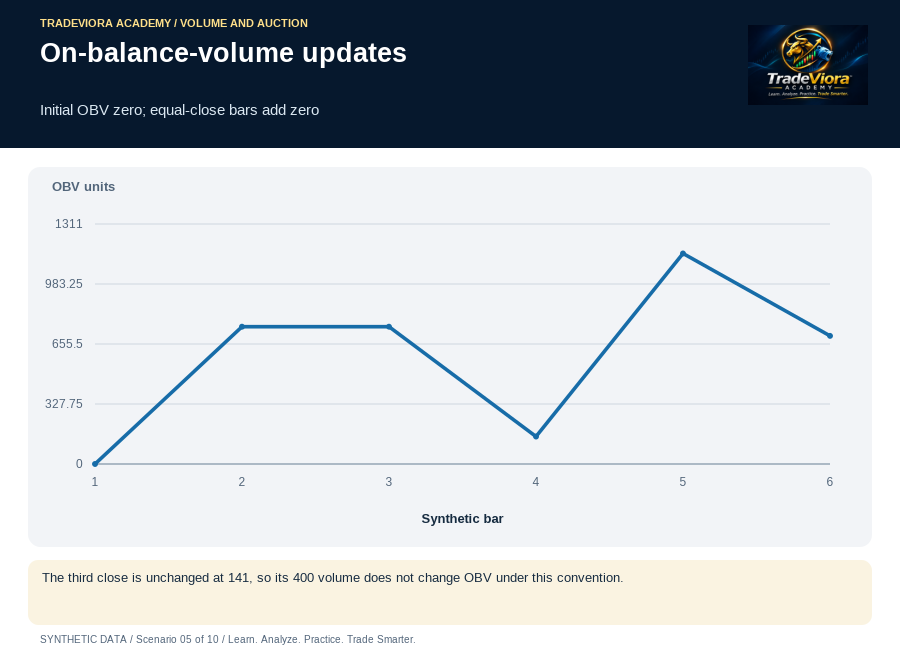
This separate synthetic case illustrates the arithmetic behind the topic. Its invented inputs are independent of the worked example above.
On-balance-volume updates · Initial OBV zero; equal-close bars add zero. The third close is unchanged at 141, so its 400 volume does not change OBV under this convention.