
1. What weights each price in exact VWAP?
- Its traded quantity
- Its timestamp alone
- Its candle colour
Reveal answer and explanation
A. Larger quantity contributes proportionally more to the weighted average.
VWAP is cumulative traded value divided by cumulative volume.
Free lessonVWAP is cumulative traded value divided by cumulative volume.
Exact VWAP uses the sum of transaction price times quantity divided by total quantity. With bars, HLC 3 times volume is a common approximation and may differ from exact trade-level VWAP. Specify the reset boundary, treatment of zero volume and instrument.
100 shares at 100 and 200 at 103 give VWAP 102.
Values from the example above, in order of appearance. Not a live chart.
Explanation: The higher price receives twice the volume weight.
Bar-based typical-price VWAP is an approximation.
Separate the observation from the trading decision. Test the rule with realistic execution and costs; a hypothetical example is not evidence of a profitable strategy.
Explore interactive trading toolsChoose an answer.
APPLIED STUDY · ORIGINAL LESSON
Before you begin: Multiply price by quantity and divide a weighted sum.
VWAP equals total traded value divided by total traded quantity over a defined window when exact transactions are used. A chart often approximates each bar with a representative price, such as typical price, multiplied by bar volume. Declare the price input and reset time. Session VWAP, anchored VWAP and rolling VWAP are different windows. Price above VWAP means above that weighted historical average; it does not by itself identify undervaluation or predict the next move.
Synthetic trades are 100 units at 50 and 300 at 52. VWAP=(100×50+300×52)/400=51.5, while the unweighted two-price average is 51. A purchase of 100 units at 51.7 is 0.2 above this benchmark, or about 0.388% of VWAP. That comparison needs matching time and instrument coverage to be meaningful.
Using final-session VWAP to trigger an earlier trade looks ahead. As cumulative volume grows, new small trades move the average less. Missing or zero volume requires explicit handling.
Add 100 units at 49 to the case. Compute the updated cumulative VWAP.
Prior traded value is 20,600. Adding 4,900 gives 25,500 across 500 units, so VWAP becomes 51.
Choose an answer before opening each explanation. These questions test the specific mechanism in this lesson.
A. Larger quantity contributes proportionally more to the weighted average.
B. The cumulative numerator and denominator are still evolving.
C. Different calculation scopes can produce different legitimate values.
Original TradeViora Academy explanation and hypothetical example. See the primary-reference scope below. External resources do not endorse or independently verify this lesson.
Updated 26 November 2026 · Educational edition · Independent editorial review pending.
Inspect actual provider-hosted market prices or load your own historical OHLCV in the Market Chart Lab. For volume-at-price and bid/ask analysis, use the profile workbench with appropriate data. These are exploration tools, not verified historical examples of this specific lesson.
The explanations, definitions used for chart labels, synthetic cases, and exercises above are original. Exchange documentation is a reference for order mechanics; it does not validate a chart strategy or identify trader intent. Indicator documentation provides formula context where applicable.
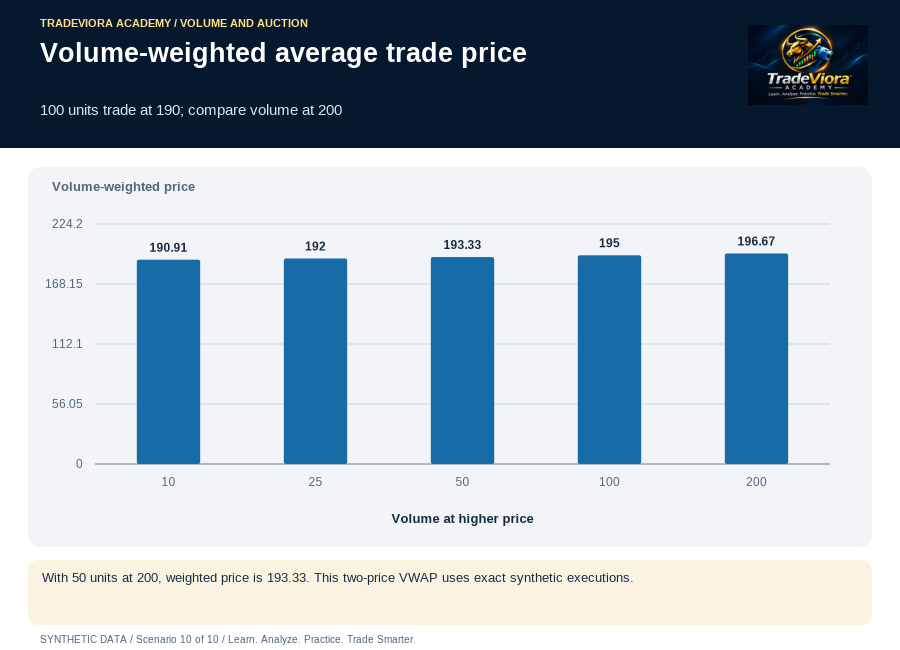
This separate synthetic case illustrates the arithmetic behind the topic. Its invented inputs are independent of the worked example above.
Download this concept’s cheat sheet · Run the related Python example · Explore scenario illustrations