FREE FINANCIAL EDUCATION
Implied volatility
Distinguish model-implied volatility from measured historical volatility.
What you will learn
Prerequisites: Option premium, moneyness and a stated pricing model.
- Distinguish model-implied volatility from measured historical volatility.
- Explain why different strikes can imply different volatilities.
- Separate a volatility forecast from the price already paid for optionality.
Mechanism and decision rules
Implied volatility is the volatility input that makes a chosen option-pricing model reproduce an observed premium, given its other inputs. It is inferred from price rather than directly observed as future realized movement. The result depends on model choice, underlying or forward reference, rates, distributions, time convention and the premium used. A bid-derived IV and ask-derived IV can define a range rather than one precise value.
Historical volatility summarizes past realized returns using a specified sampling and annualization method. It is not interchangeable with IV. Different strikes and expiries often imply different values because the market prices an entire distribution and event structure, while a simple model compresses risk into one input. Buying an option because a large move is expected is incomplete reasoning: the premium may already reflect an even larger or more expensive risk.
Worked example · synthetic data
A synthetic model with all nonvolatility inputs fixed prices a call at ₹10 when volatility is 20% and at ₹14 when volatility is 30%. A market premium of ₹12 implies some volatility between those values under a monotonic model, but not necessarily exactly 25%; pricing is generally nonlinear.
Suppose realized volatility over the previous month was 18%. An inferred 28% IV does not prove the option is overpriced. The option covers a future interval that may contain an event absent from the historical sample, and its price may include risk compensation and supply–demand effects.
Failure modes and limits
Stale or crossed quotes can produce unstable or impossible inversions. Deep ITM options with little residual value can be sensitive to small input errors. Annualization conventions and units must match. IV is a model parameter, not a guaranteed future standard deviation or a direct probability of profit.
Practice case
Two otherwise identical options have bid-implied IV 22% and ask-implied IV 26%. Why is quoting 24% as a guaranteed executable volatility misleading? What inputs must remain fixed for a meaningful comparison?
Reveal the worked answer
The midpoint IV is an analytical mark; actual execution may occur nearer bid or ask or not fill at all. Keep underlying reference, strike, expiry, rates, distributions, model and time convention consistent. A change in any of them can change the inferred IV without a simple change in market uncertainty.
Check your understanding
Sources and next steps
The lesson, calculations and synthetic cases are original educational material. References explain underlying contract or chart conventions; none validates the profitability of a trading rule. Actual contract specifications, settlement obligations and charges must be checked before trading.
Explore OHLCV data in the chart lab · Explore volume-at-price and TPO data · Practice library
Related quantitative practice
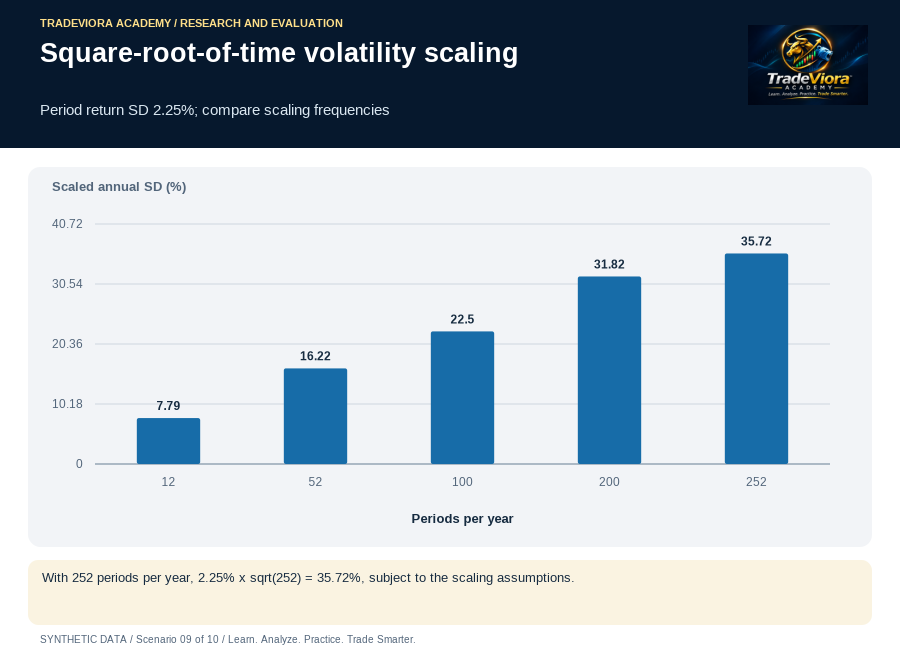
This separate synthetic case illustrates the arithmetic behind the topic. Its invented inputs are independent of the worked example above.
Download this concept’s cheat sheet · Run the related Python example · Explore scenario illustrations
Apply the measurement to genuine historical data
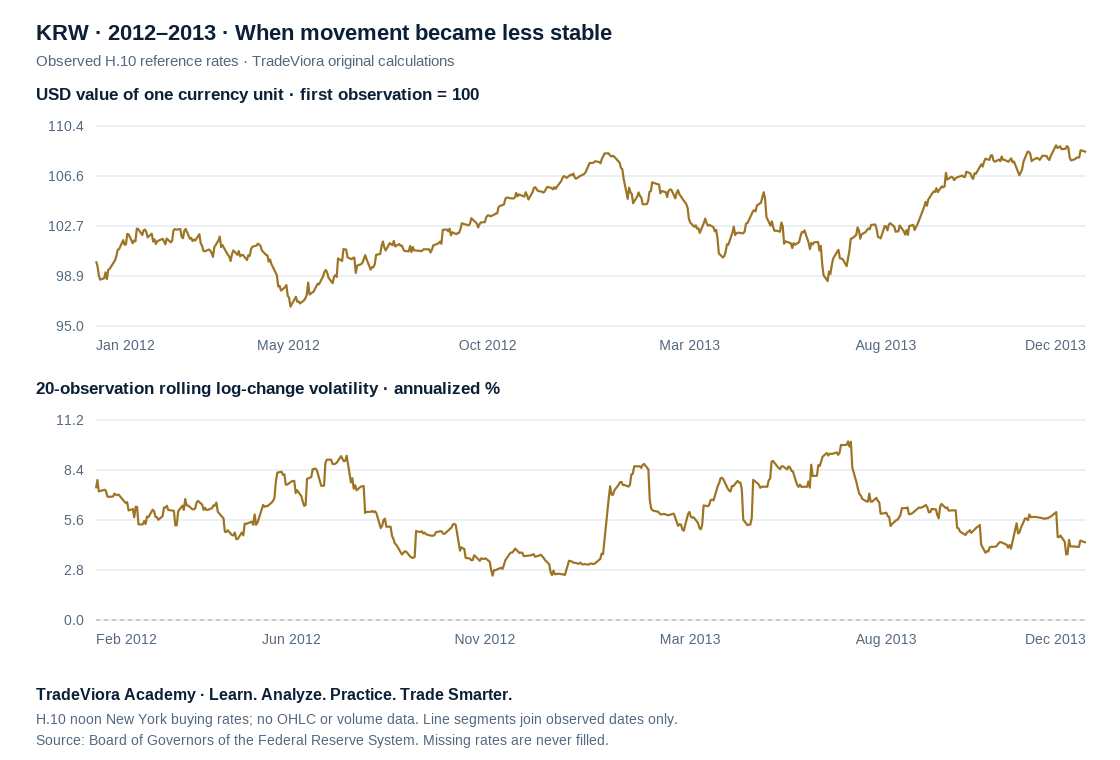
South Korean won, 2012–2013: when movement became less stable uses Federal Reserve H.10 reference-rate observations. It is an FX measurement exercise, not a test of a trading strategy or an OHLC candlestick record.