
FREE FINANCIAL EDUCATION
Gamma
Calculate the approximate change in delta from gamma.
What you will learn
Prerequisites: Delta, local approximations and option position signs.
- Calculate the approximate change in delta from gamma.
- Use the second-order term in a small-move option-value approximation.
- Explain why a delta-neutral short-gamma position can become directional.
Mechanism and decision rules
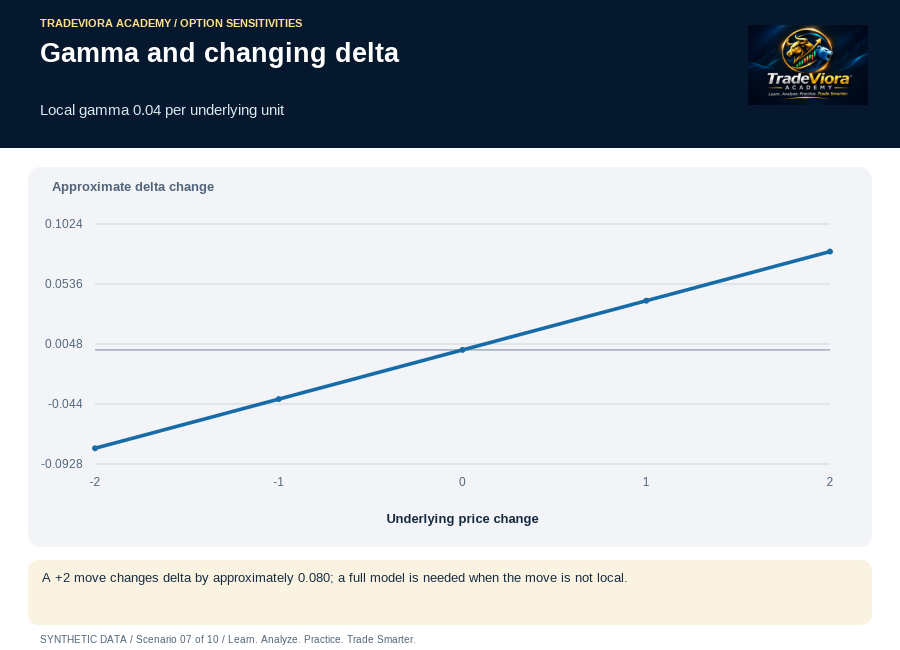
Gamma measures how delta changes for a small underlying-price change. With gamma Γ and move ΔS, new delta is approximately old delta + ΓΔS, holding other inputs fixed. The option-value approximation adds a curvature term: ΔV ≈ delta × ΔS + one-half × Γ × (ΔS)^2. A long standard call or put has positive gamma under common models; short positions reverse that exposure.
Positive gamma means the position’s delta tends to become more favorable as the underlying moves, while negative gamma tends to become less favorable. That benefit is not free: long options often incur time decay and can lose from implied-volatility declines. Near expiry, sensitivities can change sharply around a strike, making large-move approximations unreliable.
Worked example · synthetic data
A synthetic long call has delta 0.50 and gamma 0.04 per ₹1. For a ₹2 underlying rise, delta becomes approximately 0.58. The second-order value estimate is 0.50 × 2 + 0.5 × 0.04 × 4 = ₹1.08 per unit, compared with ₹1 from delta alone.
For a ₹2 decline, the estimate is −₹1 + ₹0.08 = −₹0.92. The positive curvature term appears for either direction because the squared price move is positive. These are local approximations, not exact option quotes.
Failure modes and limits
Gamma itself changes with price, time and volatility, so repeated large-step estimates can drift badly. Position gamma must include contract units and signs. A hedge that sets delta to zero now can become directional after a move. Rehedging incurs costs and cannot perfectly neutralize jumps.
Practice case
An option has delta 0.30 and gamma 0.02. For a small ₹3 rise, estimate new delta and second-order value change per unit. Ignore time and volatility changes.
Reveal the worked answer
New delta is approximately 0.30 + 0.02 × 3 = 0.36. Value change is 0.30 × 3 + 0.5 × 0.02 × 9 = ₹0.99. Using delta alone would give ₹0.90; the curvature term contributes ₹0.09.
Check your understanding
Sources and next steps
The lesson, calculations and synthetic cases are original educational material. References explain underlying contract or chart conventions; none validates the profitability of a trading rule. Actual contract specifications, settlement obligations and charges must be checked before trading.
Explore OHLCV data in the chart lab · Explore volume-at-price and TPO data · Practice library
Related quantitative practice
This separate synthetic case illustrates the arithmetic behind the topic. Its invented inputs are independent of the worked example above.
Download this concept’s cheat sheet · Explore scenario illustrations